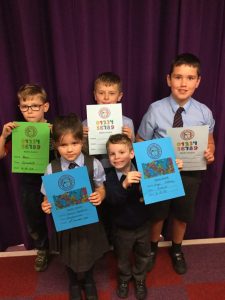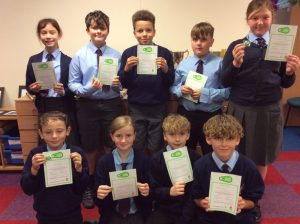
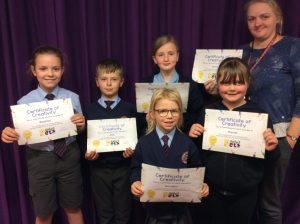
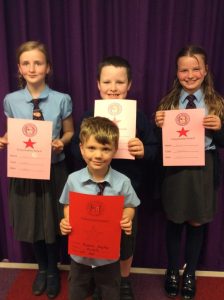
Well done to our amazing Year Six pupils as they receive their Level Three pass certificates and badges!
Well done to our amazing Year Six pupils as they receive their Level Three pass certificates and badges!
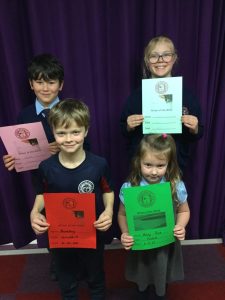
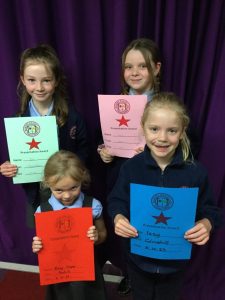
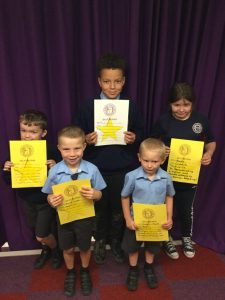
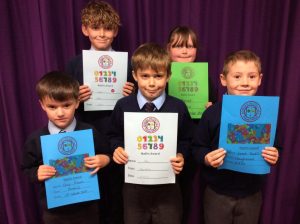
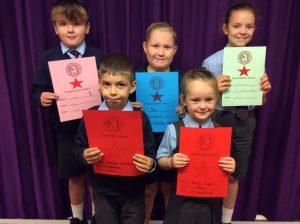
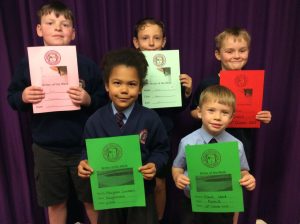
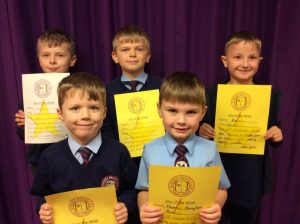
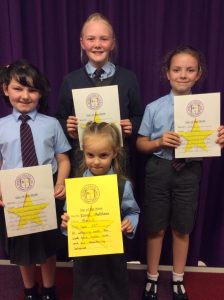
Here are the Maths, Presentation, Writing and Star of the Week certificate winners for this week!
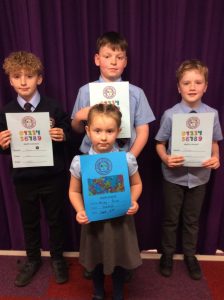
We are delighted to announce that some of the children from After School Club recently entered an art competition to design their perfect pet, their artwork has been chosen, and will be published in a book ‘Perfect Pets.’ The children will have a certificate presented to them in our achievement assembly on Friday. The book will be on-sale in December.
Well done to Ellis and Lara in Wrekin Class!
Ellis said, “I am very proud that my picture was chosen!”
Lara said, “I feel excited because it is going to be in a book that so many people can see!”
Reading: 20 minutes per day – please write in your Reading Diary! Then Fiction Express please! Also- please complete the comprehension attached!
Spelling: Rehearse your spellings from your small blue spelling book each day ready for a test next Thursday!
Maths: TTRS! Then the Square Numbers Maze attached
Year 5 and 6
Letter String ‘ough’ (again!)
afterthought
forethought
ought
wrought
breakthrough
thoroughbred
throughout
doughnut
furlough
sourdough
thoroughfare
plough
Year 5 and 6
Letter String ‘ough’
bought
brought
fought
nought
thought
enough
rough
tough
cough
trough
although
dough
though
through
borough
thorough
bough
drought
Wrekin Homework – 29/9/23 – Hand in BY next Wednesday please!
Reading: 20 minutes per day – please write in your Reading Diary! Then Fiction Express please (there are 3 live chapters!)
Spelling: Rehearse your spellings from your small blue spelling book each day ready for a test next Thursday!
Maths: Complete the addition sheets please! Then do TTRS!
We have been looking at contractions this week – here are the spellings!
should’ve
could’ve
would’ve
must’ve
might’ve
mustn’t
won’t
mightn’t
you’re (your)
shan’t
it’s (its)
Parents and carers – find out more here!
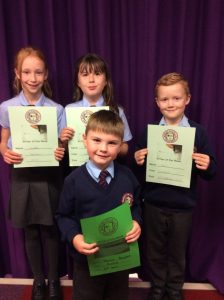
Wow! Look at our weekly certificate winners, who received their awards in Worship on Friday! Haughmond pupils will receive theirs on Monday!
Bomere Heath CE Primary School
The Crescent,
Bomere Heath,
Shrewsbury,
SY4 3PQ
Tel: 01939 290359
Head of School: Mrs Sallie Roberts
Office Manager: Maria Whittaker